Is Water Damage Fixable? What West Palm Beach Homeowners Need to Know
Reviewed by our editorial team for accuracy
Quick answer: Most water damage is fixable when addressed within 24 to 48 hours. Structural materials like drywall, framing, and flooring can often be dried and restored if exposure is brief; beyond 48 hours, mold colonization and material breakdown typically shift the answer from repair to replace. The water source, material porosity, and elapsed time are the three variables that determine outcome.
Repair or Replace? The Framework That Actually Answers the Question
The answer to whether water damage is repairable depends on three converging variables, not one—and in West Palm Beach, the clock on a viable repair outcome runs faster than national guidance suggests.
The three variables: water source, material porosity, and elapsed time
Every repair-or-replace decision starts here:
1. Water source (contamination class)
- Category 1 (clean water): Supply line break, rain intrusion through a roof—lowest contamination risk, widest repair window
- Category 2 (gray water): Washing machine discharge, overflow from sinks—microbial load present, narrows options
- Category 3 (black water): Sewage backup, floodwater from the street or a canal—replacement is almost always the correct call for porous materials, no exceptions
Category 3 exposure is not an edge case in West Palm Beach. Much of the city sits within FEMA Special Flood Hazard Areas where storm surge and sheet-flow events push canal and stormwater intrusion directly into homes. The Surficial Aquifer sits shallow beneath the soil, meaning groundwater can wick upward through slab edges during prolonged saturation.
2. Material porosity
High-porosity materials—drywall, fiberglass insulation, particleboard subfloor, carpet padding—absorb contamination and moisture at a depth that surface drying cannot reverse. Low-porosity materials—concrete, ceramic tile, solid hardwood—can often be restored if water extraction begins quickly.
3. Elapsed time
This is where West Palm Beach conditions compress your margin the most. More on that below.
Why West Palm Beach's humidity shrinks your safe repair window
How long does water damage restoration take? Structural drying under controlled conditions typically runs 3–5 days for a Class 1 or Class 2 loss. A Class 3 or Class 4 event—where moisture has saturated framing, subfloor, or wall cavities—can extend the drying phase to 7–10 days even with professional-grade dehumidification running continuously.
The problem locally is what happens during those days if professional water extraction and dehumidification are delayed. West Palm Beach's average relative humidity sits above 75% for most of the year. At that ambient humidity, mold colonization can begin within 24–48 hours on wet drywall and insulation—roughly half the window that national restoration guidelines assume. Pre-1980 homes, which make up a significant portion of West Palm Beach's housing stock, frequently have older paper-faced drywall and non-treated framing that absorbs moisture faster and holds it longer.
Florida Building Code and Palm Beach County Floodplain Management requirements add another layer: repairs to structures in Special Flood Hazard Areas may trigger substantial improvement thresholds that affect what you're permitted to restore versus what must be rebuilt to current elevation standards. That's a regulatory variable most generic repair guides ignore entirely.
Drywall, flooring, and framing: material-by-material verdicts
| Material | Repair threshold | Replace when… |
|---|---|---|
| Drywall | Surface staining only, no swelling, Category 1 source | Swelling or sag exceeds ⅜ inch; any Category 2–3 exposure; mold present |
| Hardwood flooring | Minor cupping, moisture content returning to normal | Buckling, subfloor saturation, or gray/black water contact |
| Carpet and pad | Almost never salvageable after 24–48 hours | Category 2–3 source, or any delay in extraction |
| Subfloor (OSB/particleboard) | Rare; only if caught within hours and Category 1 | Swelling, delamination, soft spots, or extended saturation |
| Framing lumber | Structurally sound after drying; treat for mold | Active mold colonization, visible rot, or Category 3 saturation |
The drywall threshold—a ⅜-inch deflection from baseline—is a useful field test, but it's a lagging indicator. By the time drywall visibly sags, the moisture has often already penetrated the cavity behind it. In a humid climate where the mold colonization window is compressed, waiting for visible damage to confirm a replacement decision costs days you don't have.
Water damage is repairable when contamination is low, materials are low-porosity, and professional structural drying begins fast. In West Palm Beach, that window is narrow—and the local flood zone exposure, ambient humidity, and older housing stock make a conservative replacement threshold the more defensible choice in most real-world scenarios.
How Water Damage Repairs Actually Work, Step by Step
Once the repair-or-replace decision is made, restoration follows a fixed sequence. Skipping or compressing any step doesn't accelerate recovery—it transfers the damage forward, usually into a mold or structural problem that costs more to resolve.
Water extraction: the step nothing else can skip
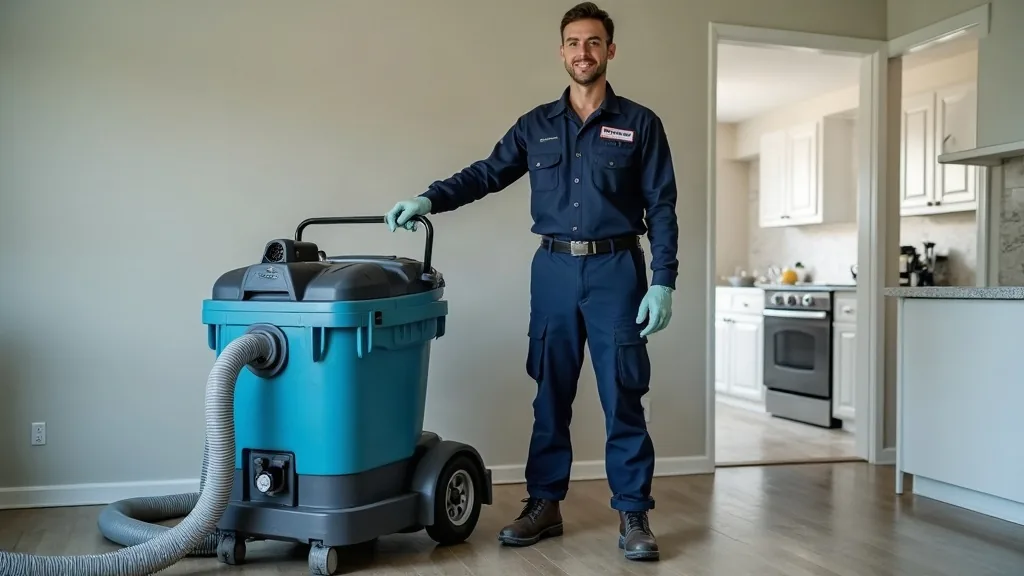
Structural drying cannot begin while standing water or saturated material is still present. Extraction comes first, using truck-mounted or portable wet-vac equipment rated for the volume and water category involved.
The classification matters here. Category 1 clean water—a supply line break, for example—allows faster material triage. Category 2 gray water (appliance discharge, overflow) and Category 3 black water (sewage, floodwater) require full containment protocols before any other work proceeds. In West Palm Beach homes located in FEMA Special Flood Hazard Areas, floodwater almost always qualifies as Category 3 regardless of appearance, because it has contacted the Surficial Aquifer and ground-level contaminants.
Speed is the practical constraint. In South Florida's ambient humidity, the mold colonization window opens within 24 hours of saturation—not 48–72 hours as some national guidelines suggest.
Structural drying and dehumidification
After extraction, the goal is returning structural materials to equilibrium moisture content before secondary damage sets in. This requires industrial dehumidification and air movers positioned to drive moisture out of wall cavities, subfloor assemblies, and framing—not just surface evaporation.
Monitoring is non-negotiable. Technicians use moisture meters and thermal imaging to confirm drying progress across the Class 1–4 water damage classification spectrum, where Class 4 involves materials like concrete and hardwood that require extended low-humidity drying cycles. A typical residential structural drying cycle runs 3–5 days under controlled conditions; older pre-1980 construction in West Palm Beach often extends that timeline due to denser framing and less air movement in closed wall systems.
Disinfection, mold inspection, and content restoration
How much does water damage restoration cost in West Palm Beach? Scope drives cost. Basic water damage restoration—extraction and drying only, no reconstruction—typically runs $3.75–$7.00 per square foot depending on water category, affected area, and access difficulty. Category 3 events, which require antimicrobial treatment and containment, sit at the higher end of that range. Reconstruction costs are separate and depend on material replacement scope identified during drying.
Disinfection targets all surfaces with Category 2–3 exposure. Mold inspection follows structural drying—not before—because moisture readings during active drying don't yet reflect equilibrium conditions. If mold colonization is confirmed, remediation protocols under Florida Building Code standards apply before any reconstruction begins.
Salvageable contents—furniture, cabinetry, documents—move through a parallel assessment track. Porous materials with Category 2–3 contact are generally not restorable; non-porous items can often be cleaned and returned.
Permitting and reconstruction in West Palm Beach
Reconstruction in West Palm Beach isn't always a straight rebuild. The City of West Palm Beach Building Division requires permits for structural work, electrical, and plumbing—and Palm Beach County Floodplain Management reviews apply to any property in a designated Special Flood Hazard Area. If the repair scope reaches the substantial improvement threshold (typically 50% of the structure's pre-damage market value), the project must be brought into compliance with current flood elevation standards.
That regulatory layer is why the repair-or-replace framework covered earlier in this article isn't just a materials question—it's also a permitting and cost exposure question. Knowing the classification, the flood zone status, and the drywall replacement threshold before reconstruction begins determines whether a repair permit becomes a full elevation project.
How Long Does Water Damage Restoration Take—and What Does It Cost in West Palm Beach?
Restoration timelines and costs are direct functions of damage class—not square footage alone. West Palm Beach conditions compress both variables in ways national estimates don't capture.
Typical timelines by damage class
The IICRC's Class 1–4 classification system describes how much water a structure has absorbed, which determines drying time more reliably than the event's duration.
| Damage Class | Description | Typical Drying Window |
|---|---|---|
| Class 1 | Minimal absorption, hard surfaces | 2–3 days |
| Class 2 | Significant absorption, carpet and lower walls | 3–5 days |
| Class 3 | Full saturation, walls and ceilings | 5–7 days |
| Class 4 | Specialty drying—concrete, hardwood, plaster | 7–14+ days |
In West Palm Beach, those windows tighten at the top end. South Florida's ambient humidity slows the vapor pressure differential that structural drying equipment relies on, and dehumidification systems work harder to maintain target grain levels. Pre-1980 construction—dense framing, plaster walls, minimal wall cavity airflow—consistently extends Class 3 and Class 4 jobs beyond the shorter end of any published range.
Mold colonization can begin within 24–48 hours under South Florida conditions. That reality means water extraction delay doesn't just stretch the timeline; it converts a drying project into a combined drying-and-remediation project, with separate permitting and cost implications.
Is emergency water damage restoration available 24/7? Vetted specialists in the West Palm Beach market operate on 24-hour response because the mold window doesn't observe business hours—and because FEMA Special Flood Hazard Area properties face regulatory scrutiny that rewards documented, prompt response.
How much does water damage restoration cost in West Palm Beach?
Extraction and structural drying without reconstruction typically runs $3.75–$7.00 per square foot, depending on water category and site conditions. Category 3 black water events—requiring full containment, antimicrobial treatment, and protective equipment—sit at the higher end. Category 1 clean water events with early extraction sit at the lower end.
Key cost variables specific to this market:
- Flood zone status: SFHA properties often require Palm Beach County Floodplain Management documentation, which adds administrative scope
- Water category escalation: Gray water (Category 2) or black water (Category 3) exposure requires drywall replacement at lower moisture thresholds than Category 1, expanding material scope
- Building age: Pre-1980 homes may require longer equipment run times and more drying equipment, both billed as line items
Reconstruction costs are priced separately and depend entirely on the drywall replacement threshold findings and material scope confirmed after drying—not before.
Finding the Right Help in West Palm Beach: 24/7 Emergency Response and What to Look For
Is emergency water damage restoration available 24/7?
Yes—and in West Palm Beach, 24/7 availability isn't a marketing claim, it's a structural requirement. South Florida's humidity compresses the mold colonization window to 24–48 hours, meaning a Category 2 gray water event that starts at 11 p.m. on a Friday carries the same urgency as one that starts Monday morning. Specialists serving this market operate on continuous dispatch because the damage classification can escalate overnight if water extraction is delayed.
Is there a water damage restoration company near me in West Palm Beach?
Yes—vetted water damage restoration specialists operate throughout West Palm Beach and surrounding Palm Beach County. Response proximity matters here for a specific reason: pre-1980 housing stock in areas like Northwood and El Cid absorbs moisture faster through plaster walls and dense framing, making early water extraction—not just fast arrival—the variable that keeps a job at Class 2 rather than Class 3 or 4.
Questions to ask before you hire anyone
Not all restoration contractors carry equal capability for South Florida conditions. Before authorizing work, ask:
- Are you licensed under Florida Building Code requirements and familiar with City of West Palm Beach Building Division permit thresholds? Structural drying that crosses into reconstruction typically requires a permit.
- Can you document moisture readings for FEMA Special Flood Hazard Area compliance? Palm Beach County Floodplain Management may require this for properties in mapped SFHA zones.
- How do you determine the drywall replacement threshold? This should be based on moisture meter readings at specific depths—not visual inspection alone.
- Do you carry equipment for Surficial Aquifer-influenced groundwater intrusion? Events driven by Category 3 black water from below require containment protocols that differ from roof or pipe leaks.
A contractor who can answer these concretely is calibrated for this market. One who can't likely trained on national protocols that don't account for West Palm Beach's specific flood zone exposure and humidity conditions.
Palm Beach Restoration Pros connects you with licensed local contractors. One call, no form.
Call (561) 342-0374Frequently Asked Questions
How long does water damage restoration take?
Water damage restoration typically takes 3 to 5 days, though severe cases can take 1 to 2 weeks. Drying alone usually requires 2 to 3 days. Factors like affected area size, material type, and damage severity all influence the timeline for complete restoration.
How much does water damage restoration cost in West Palm Beach?
Water damage restoration in West Palm Beach typically costs between $1,300 and $5,500, depending on damage severity and affected square footage. Minor repairs may cost a few hundred dollars, while major flooding or structural damage can exceed $10,000. Insurance often covers a significant portion.
Is emergency water damage restoration available 24/7?
Yes, Palm Beach Restoration Pros offers 24/7 emergency water damage restoration in West Palm Beach. Water damage worsens rapidly, so immediate response is critical. Our local pro network is ready around the clock to extract water, begin drying, and prevent mold growth from developing within 24 to 48 hours.
Is there a water damage restoration company near me in West Palm Beach?
Yes, Palm Beach Restoration Pros is a locally based water damage restoration company serving West Palm Beach and surrounding Palm Beach County communities. Our local team provides fast on-site response times, ensuring water extraction and drying begins quickly to minimize property damage and restoration costs.
Is water damage fixable?
Yes, most water damage is fixable when addressed promptly by professionals. Restoration specialists can dry structures, repair drywall, treat mold, and restore flooring effectively. The sooner restoration begins, the better the outcome. Delays beyond 48 hours significantly increase damage severity and overall repair costs.